

Feb 27, 2026
Careers in Offensive AI Security: Roles, Skills, and Pathways
At OffSec, we are building OSAI, our offensive AI security certification, to help practitioners extend adversary-driven methodology into AI-enabled environments already entering production. That initiative reflects a broader shift happening across the industry. As AI-enabled features move into production systems, customer platforms, and internal operations, organizations are recognizing that these capabilities expand the attack surface
 OffSec Team
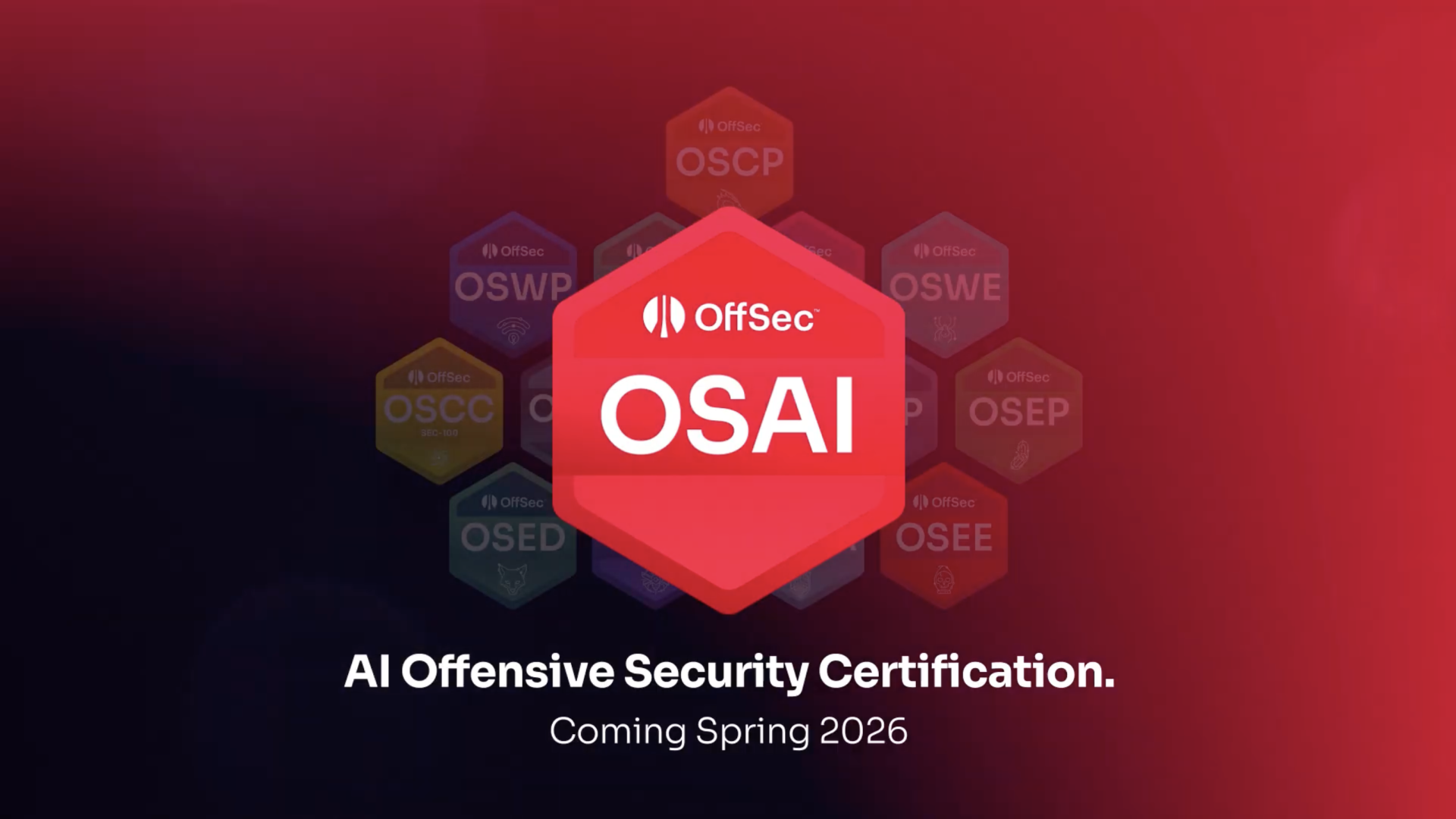
At OffSec, we are building OSAI, our offensive AI security certification, to help practitioners extend adversary-driven methodology into AI-enabled environments already entering production.
That initiative reflects a broader shift happening across the industry. As AI-enabled features move into production systems, customer platforms, and internal operations, organizations are recognizing that these capabilities expand the attack surface and introduce new risks that traditional testing does not fully address.
With that shift comes an opportunity for offensive practitioners who are willing to evolve early, expand their scope, and build the skills required to test modern systems effectively.
So what do careers in offensive AI security actually look like?
While titles are still evolving, several patterns are already clear.
AI Red Team Operators simulate adversarial attacks against AI-enabled systems in production environments. Their work may include:
- Prompt injection and model manipulation
- Exploiting RAG pipelines
- Testing multi-agent workflows
- Identifying tool abuse paths
- Chaining AI weaknesses into broader compromise
AI red team operators think beyond single vulnerabilities, assessing how models, data, infrastructure, and integrations combine into exploitable systems.
This role focuses on discovering new attack techniques against models, embeddings, agent frameworks, and AI supply chains.
AI security researchers often:
- Develop novel exploitation techniques
- Analyze model extraction and adversarial ML risks
- Test emerging agent protocols
- Publish findings that shape defensive standards
Many penetration testers are already encountering AI-enabled features during engagements. Increasingly, clients expect testing of:
- LLM-powered applications
- AI-driven automation workflows
- AI-integrated SaaS tools
- Retrieval and knowledge pipelines
This role expands traditional pentesting methodology to include adversarial AI testing techniques.
In organizations building AI-powered products, internal security teams need professionals who understand how attackers target AI components. They might:
- Red team new AI features before release
- Threat model AI components and integrations
- Test RAG pipelines and agent workflows
- Translate findings into engineering fixes
This role bridges offensive testing and secure AI development. It requires understanding both exploitation and mitigation tactics.
While roles are still forming, the underlying capabilities are becoming clear!
Offensive AI security requires practitioners who can map AI-enabled attack surfaces, test probabilistic systems, exploit RAG pipelines and agent workflows, assess AI supply chain risk, and translate model weaknesses into meaningful business impact.
These are not entirely new fundamentals, but they demand adaptation. The adversary mindset remains the same. The environment has changed.
For a deeper breakdown of the offensive AI security skills shaping this field, read our guide to the offensive AI security skills that will matter in 2026.
For experienced offensive practitioners, the transition is evolutionary, not revolutionary.
And while the environment changes, the core mindset remains the same:
- Think like an attacker
- Map trust boundaries
- Chain weaknesses
- Prove impact
Here are practical pathways to begin transitioning:
During engagements, actively assess AI components instead of treating them as black boxes.
Experiment with open-source LLM frameworks, RAG pipelines, and agent tooling. Build and break your own environments.
Develop an understanding of model extraction, embedding attacks, and agent manipulation.
Move beyond isolated tests. Practice attacking full AI-enabled workflows that combine models, tools, data, and infrastructure.
AI adoption is accelerating faster than defensive standards are maturing.
Security teams are being asked to assess AI systems without established playbooks. Organizations need practitioners who can apply offensive methodology to AI-enabled environments in a structured, repeatable way.
That creates opportunity.
Practitioners who develop offensive AI security skills now will be positioned for:
- Specialized AI red team roles
- Higher-value consulting engagements
- Product security leadership positions
- Research influence in a rapidly forming domain
This is the early phase of a long-term shift in offensive operations.
As AI reshapes the attack surface, training and methodology need to evolve with it.
OSAI, OffSec’s offensive AI security certification, extends the adversary-driven approach to AI-enabled systems. It focuses on realistic labs, attacker workflows, and practical red team scenarios that reflect how AI is deployed in production today.
Rather than treating AI as a theoretical add-on, OSAI approaches it as an operational attack surface.
For practitioners looking to move into offensive AI security, structured, hands-on training can accelerate that transition!