
Nov 25, 2026
Redesign Your Cyber Workforce Before AI Does It for You
Part 2 of how AI is reshaping the cyber workforce where we offer a model to support this. Free infographic download included!
 OffSec Team
In the first article, AI Is Reshaping the Cyber Workforce, we examined how automation redistributes accountability, changes the experience available to junior practitioners, and increases the importance of offensive judgment. Those changes give security leaders a development agenda. The next question is how to put it into practice.
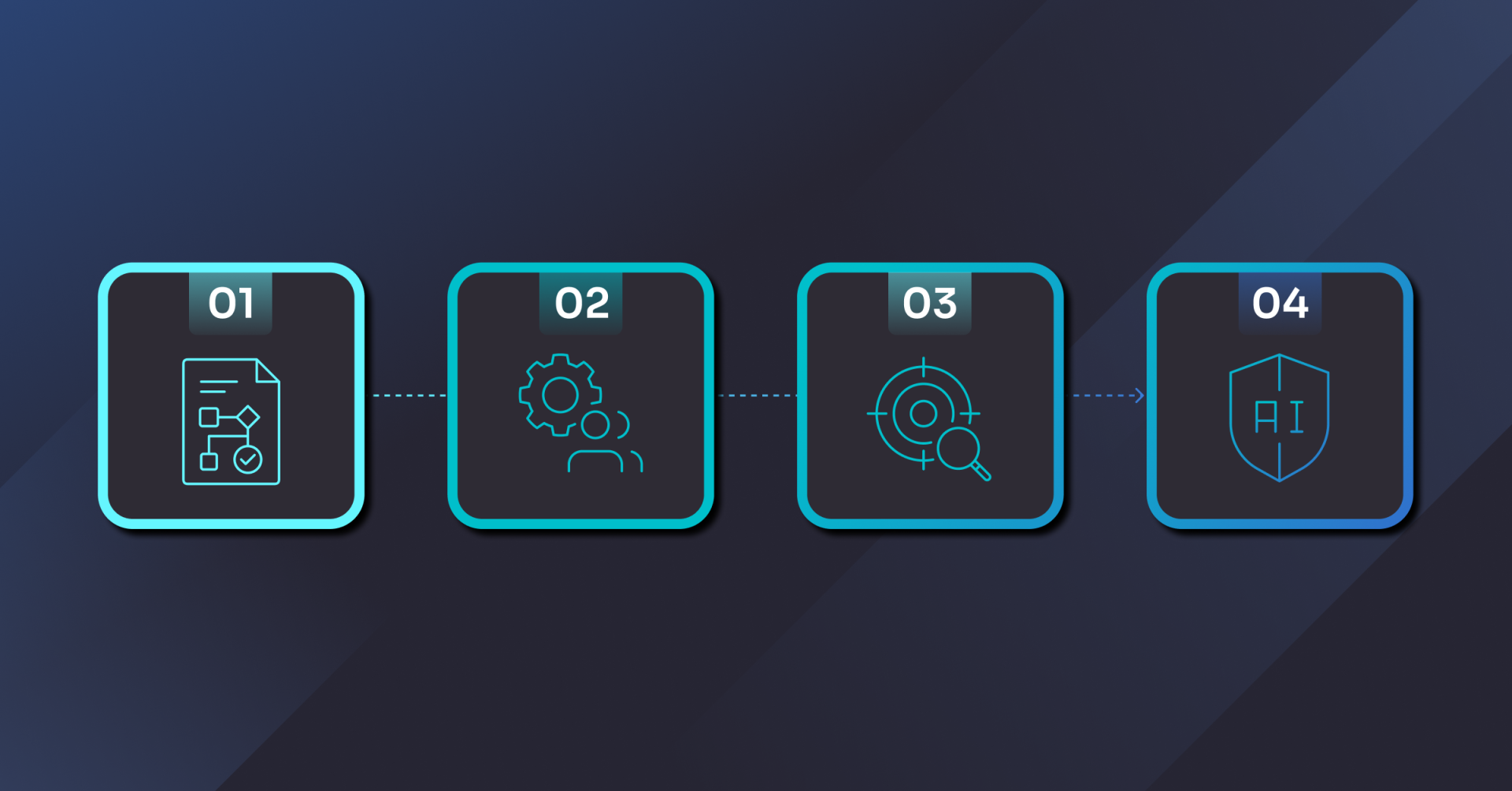
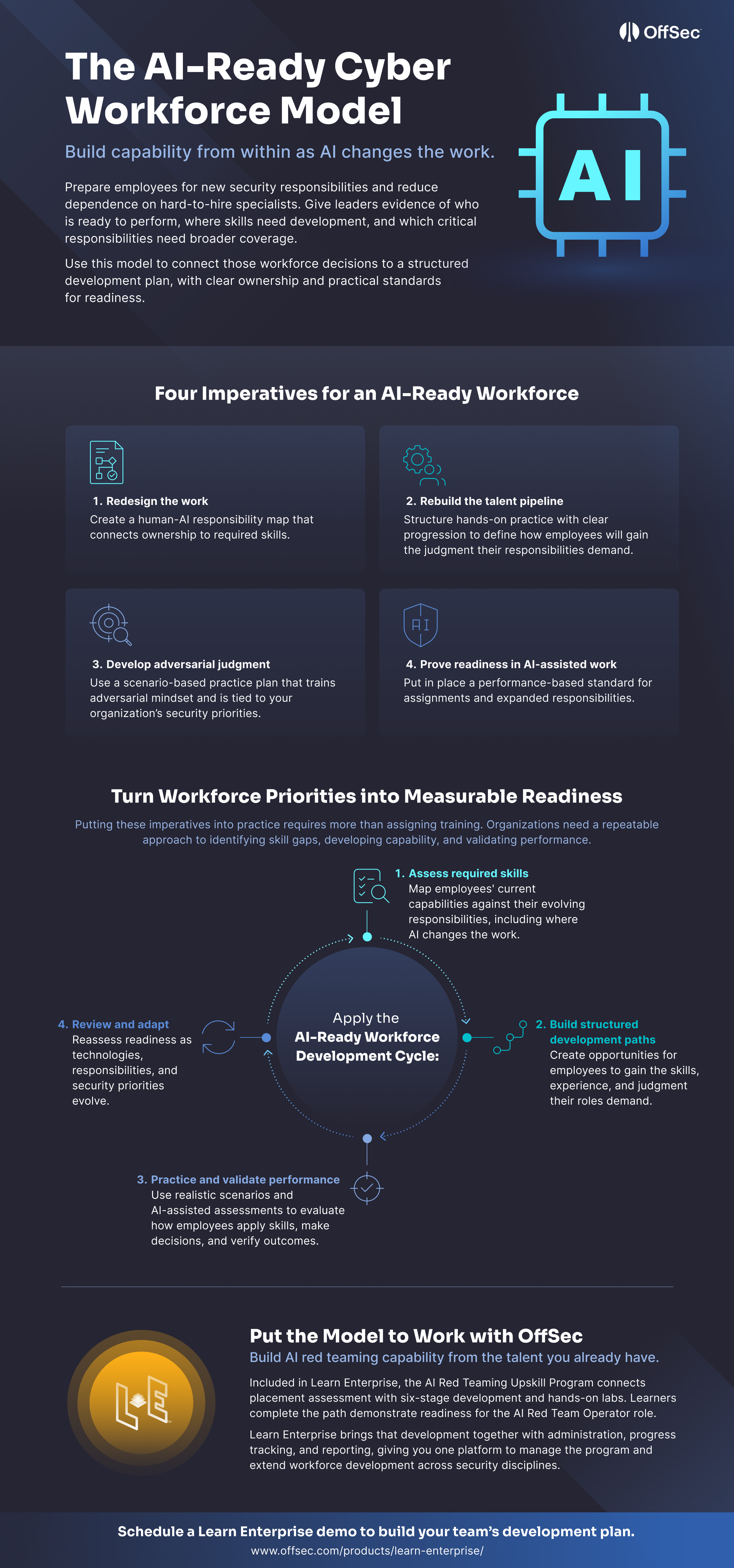
The AI-Ready Cyber Workforce Model connects that agenda to four imperatives: redesign the work, rebuild the talent pipeline, develop adversarial judgment, and prove readiness in AI-assisted work.
Each imperative produces something leaders can use: a responsibility map, an experience pathway, a scenario-based practice plan, and a readiness standard. A repeatable development cycle then connects those outputs to training, assessment, and assignment decisions.
Here, we explain how to apply the model and use Learn Enterprise’s AI Red Teaming Upskill Program to build an emerging capability from existing talent.
Create a human-AI responsibility map for the workflows you want to improve. For each workflow, document what AI contributes, which decisions require review, and who has authority to approve the next action.
Make the conditions for intervention explicit. Specify what employees should do when information is missing, the result falls outside expected conditions, or the recommended action exceeds their authority.
Then use the map to define development requirements. Someone responsible for validating a recommendation needs the technical knowledge to examine its assumptions and the operational context to assess its consequences. Describe those requirements as observable tasks that can be practiced and assessed.
The map becomes a shared reference for managers and employees: what the role owns, what competent performance requires, and where escalation is expected.
For each responsibility in the map, define how employees will gain the experience needed to assume it.
Build a progression with observable performance requirements. An initial assignment might require an employee to investigate a bounded case and explain their decision. Later assignments can introduce conflicting evidence, incomplete information, or activity spanning several systems.
Set the progression criteria before assigning the training. Specify what employees must demonstrate independently, which decisions require review, and what performance would justify greater responsibility.
The output is a deliberate experience pathway connecting practice to expanded responsibility. Managers can use it to identify the experience an employee still needs before assigning consequential work.
Build the practice plan around the attack objectives and defensive gaps that matter to your organization.
For each scenario, define what the employee must investigate, what information they will have, and which assumptions they should test. Include opportunities to pursue more than one plausible explanation so the exercise reveals how they choose and revise an approach.
Review the investigation as well as the outcome. Which evidence did the employee prioritize? What did they overlook? Did they recognize when a failed technique required a different approach? Could they explain how individual findings contributed to the attack objective?
Use those observations to shape the next assignment. A practitioner who misses an access relationship needs different practice from one who identifies it but cannot validate its impact.
The result is a scenario-based practice plan tied to specific development needs, with feedback employees can act on.
Define the readiness standard before running the assessment. Base it on the responsibilities employees will assume and allow the AI tools available in the role.
Observe how employees frame the problem, supply relevant context, verify generated output, and respond when the tool produces a weak or misleading result. Require them to explain the evidence supporting their final decision and identify anything they could not establish.
Agree on what constitutes sufficient performance and what requires further development. Record the responsibilities the assessment supports so that a successful result leads to an appropriate assignment or progression decision.
This gives managers a performance-based readiness standard they can apply consistently. Employees can see what they need to demonstrate and where further practice is required.
The four imperatives define the changes workforce strategy must address. The Workforce Capability Development Cycle provides a repeatable way to carry them out:
- Define required capabilities.
- Establish a reliable baseline.
- Create a structured progression.
- Require practical application.
- Validate readiness through performance.
- Review and repeat.
Use the responsibility map to define required capabilities and assess employees against relevant tasks. Build their progression from the baseline, provide practical assignments, and apply the readiness standard before expanding responsibility.
Review results at both individual and team levels. An individual assessment can guide the next assignment. Aggregated results show whether the organization is improving coverage or continuing to depend on a few specialists.
| Executive question | What to measure | What success looks like |
| Are we developing the right capabilities? | Priority roles with observable requirements; employees assessed against relevant tasks | Development aligns with required security work, with evidence of the gaps |
| Are employees demonstrating readiness? | Time to readiness, performance validation, and internal progression | Employees demonstrate capability before assuming expanded responsibilities |
| Are we reducing workforce dependency? | Coverage of critical roles and concentration of capabilities among employees | More teams have validated capability and dependence on individual specialists decreases |
Feed those findings into the next cycle. Update development priorities when assessments expose weak coverage or when a system change introduces responsibilities the team has not yet demonstrated.
AI red teaming provides a concrete first implementation. Begin by defining which AI-enabled systems the team must assess and what a successful engagement requires.
Include the model or agent and its connections to identities, permissions, applications, APIs, data sources, infrastructure, and business processes. Translate that scope into responsibilities practitioners must be able to perform and findings they must be able to substantiate.
Next, identify the foundations already present across your workforce. The capability stack below provides a reference for that assessment.
| Capability layer | Required foundations |
| Cyber foundations | Operating systems, networking, computing, and core security concepts |
| Offensive security | Web and API attacks, exploitation, and adversarial methodology |
| Modern infrastructure | Cloud, containers, applications, APIs, identity, and data |
| Red team operations | Active Directory lateral movement, evasion, and attack-path development |
| LLM red teaming | LLM behavior, manipulation, abuse, and AI-specific weaknesses |
| Advanced AI red teaming | Complex attacks against AI-enabled systems and connected environments |
Use practical baseline assessments to determine where employees should enter the development path. A practitioner with strong offensive experience may be ready to focus on AI-specific techniques. Another may need to strengthen infrastructure or exploitation skills first.
For final validation, give employees a realistic objective and require defensible findings. Assess whether they can select an approach, test assumptions, adapt when a technique fails, and explain the impact they have demonstrated.
This turns an emerging security requirement into a defined internal development initiative.
Learn Enterprise brings learning content, hands-on environments, administration, progress tracking, reporting, and program management into one platform. It gives organizations a consistent way to run development from initial assessment through practical validation.
Within it, the AI Red Teaming Upskill Program provides a structured path toward the AI Red Team Operator role.
The program’s placement assessment evaluates current competencies and recommends a starting stage. Leaders can use that starting point to direct development toward missing capabilities while building on existing strengths.
This supports a team with varied experience without requiring managers to assemble an individual curriculum from scratch for every learner.
The program organizes development into six stages, from cybersecurity foundations through advanced AI red teaming. Hands-on labs throughout the path let employees apply what they learn, while optional Stage Assessments provide performance-based validation during progression.
The combination gives learners a defined route toward the role and opportunities to identify gaps before the final performance requirement.
Program completion requires learners to complete the development path and pass an AI-300 Challenge Lab.
Synthetic Siege establishes the required final performance threshold for the program, demonstrating readiness for the AI Red Team Operator role. A separate certification exam is optional and can be pursued independently.
Leaders gain a defined completion standard to use alongside the requirements of their own environment and planned assignments.
Learn Enterprise keeps program management, progress tracking, and reporting alongside the learning environments. Administrators can manage the initiative and monitor development as employees move through the path.
This provides an operating foundation for expanding the approach beyond an initial group. Prebuilt programs, Custom Learning Paths, labs, and Cyber Ranges support additional development priorities across offensive security, security operations, incident response, threat hunting, secure development, cloud security, and other technical areas.
Organizations can build capability around a new responsibility while using the same platform to manage development across the wider security function.
Start with a responsibility map and a baseline of the expertise available in your team. Use them to identify a development priority, define the required performance, and select a structured path.
For AI red teaming, Learn Enterprise connects that planning to placement assessment, staged development, hands-on practice, and a final performance requirement. It gives organizations a practical way to develop existing talent toward an emerging security role.
Download The AI-Ready Cyber Workforce Model to guide your planning!
Build internal capability with Learn Enterprise. Schedule a demo to discuss your team’s development priorities.